
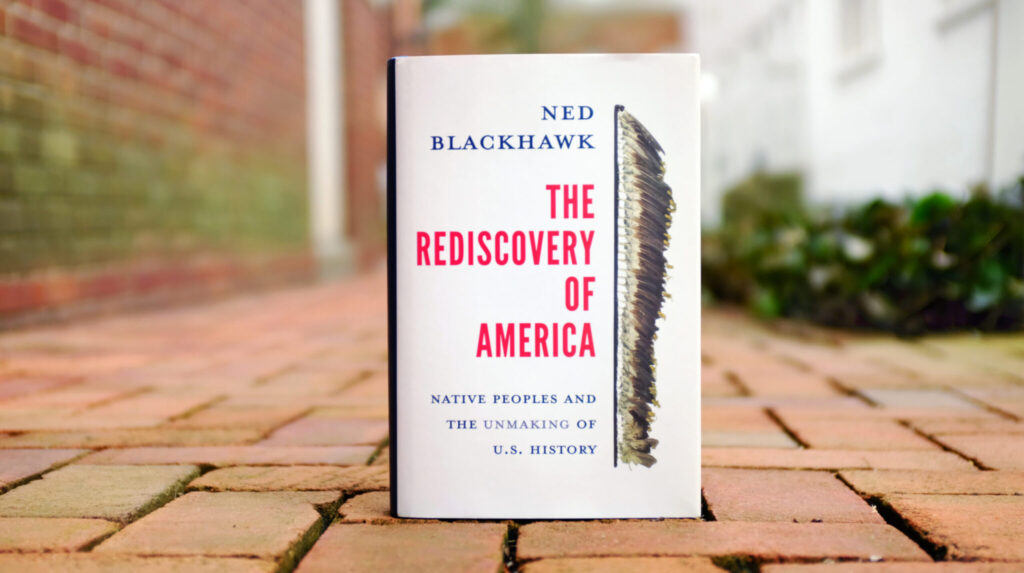
In the book The Rediscovery of America: Native Peoples and the Unmaking of U.S. History, historian Ned Blackhawk advances an argument that is as disturbing as it is well documented: Adolf Hitler did not invent settler colonial violence from nothing. He studied it. And one of his most important reference points was the United States.
Hitler repeatedly cited the American conquest of Indigenous lands as a successful model of racial expansion. He admired the way Native nations were removed, confined, starved, and erased in the name of progress. The reservation system, the frontier wars, and the logic of Manifest Destiny offered a blueprint for how a modern state could seize land, displace populations deemed “inferior,” and normalize mass death while retaining a self-image of civilization. The American example helped make genocide legible as policy.
This is not a rhetorical claim. It is a historical one. Scholars have traced how U.S. westward expansion shaped Nazi ideas about Lebensraum, racial hierarchy, and the bureaucratic management of unwanted populations. What makes Blackhawk’s intervention so unsettling is not simply that the United States inspired Hitler, but that Americans have largely refused to sit with that fact.
America’s Unfinished Racial Order
The dominant national myth insists that racism and racial violence are deviations from American ideals rather than structural features of the republic. But from the beginning, through Indigenous dispossession, slavery, segregation, exclusion laws, and forced removals, race has been foundational to American state-building.
The period in which the United States actively tried to dismantle that structure was remarkably brief. Measured against centuries of racial hierarchy, the civil rights era was a moment, not a transformation. That brevity matters when we look at the present.
Contemporary American politics has reintroduced ideas that many assumed had been permanently discredited: ethnic purity, mass deportation, collective punishment, and the redefinition of citizenship along racial and cultural lines. Donald Trump has openly used language drawn from authoritarian and fascist traditions, invoking “poisoned blood,” celebrating violence against political opponents, and framing minorities as existential threats to the nation.
These echoes do not mean history is repeating itself mechanically. But they do suggest that the ideological soil has never been fully cleared.
History Doesn’t Repeat. It Rehearses.
When people warn that contemporary American politics resembles the 1930s, critics are quick to object. History doesn’t repeat, they say. Contexts differ. Institutions remain. Comparisons are exaggerated. All of that is technically true, and dangerously incomplete.
History does not repeat itself verbatim. It rehearses. Ideas, metaphors, and governing logics lie dormant, waiting for moments when fear, grievance, and power align. When they return, they do not announce themselves as replicas. They arrive adapted.
The warning signs today are not gas chambers or formal doctrines of extermination. They are rhetorical and institutional. They appear in language that describes entire populations as contaminants. They appear in calls for mass deportation without due process. They appear in the celebration of state violence and the delegitimization of courts, journalists, and elections.
This is why comparisons to Trump are not about personal villainy or aesthetics. They are about retrieval. When leaders borrow from authoritarian traditions, whether consciously or instinctively, they draw from a long archive of exclusionary governance. That archive exists in Europe. It also exists, fully formed, in the United States.
The uncomfortable truth is that America does not need to become fascist in a European sense. It already possesses a homegrown repertoire of racial control: forced removal, legal inequality, mass incarceration, border regimes, and selective citizenship. These tools were never fully dismantled. They were repurposed, obscured, or temporarily restrained.
Why the World Is Paying Attention
This is why recent warnings from European leaders carry weight. When officials in Denmark publicly describe the United States as one of the most significant threats to global security, they are not only reacting to foreign policy unpredictability. They are responding to the destabilizing effects of a powerful state drifting away from democratic restraint while retaining immense military, economic, and cultural influence.
A state with enormous reach and unresolved internal violence becomes unpredictable not despite its history, but because of it.
Is This Comparison Fair?
Any time Hitler enters a political discussion, alarms go off. Critics accuse the speaker of exaggeration, bad faith, or moral blackmail. Comparisons are dismissed as inflammatory shortcuts rather than serious analysis. So it is worth asking the question directly: Is this comparison fair?
If the claim is that the United States today is identical to Nazi Germany in the 1930s, the answer is no. The contexts differ. The institutions differ. The outcomes are not predetermined. No serious historian argues otherwise.
But if the claim is that certain logics of power, racial exclusion, collective punishment, the normalization of state violence, and the erosion of democratic restraint are reappearing in recognizable forms, then the comparison is not only fair. It is necessary. Calling attention to these parallels is not hysterical. It is preventative.
The reflexive rejection of comparison often serves comfort more than truth. It allows societies to believe that violence always arrives in foreign uniforms, speaking a different language, under unmistakable banners. History suggests otherwise. The most dangerous forms of authoritarianism arrive wrapped in national tradition, legal justification, and popular support.
What History Asks of Us
History does not move in neat cycles, but it does carry forward unresolved structures. Violence that is never fully reckoned with does not disappear; it waits. The logic that enabled genocide against Native peoples did not die with the frontier. It traveled. It was adapted. When conditions permit, it returns, often wearing familiar symbols, speaking an updated language, and insisting that this time is different.
Blackhawk’s reminder is not that America is uniquely evil. It is that no nation is immune to its own unfinished history.
The most dangerous myth is not that genocide happened elsewhere. It is the belief that it could not happen again here, because we once convinced ourselves we had moved beyond it. History does not accuse. It instructs. Ignoring it does not make us prudent. It makes us late.
Blackhawk, Ned. 2023. The Rediscovery of America: Native Peoples and the Unmaking of U.S. History. New Haven: Yale University Press.