
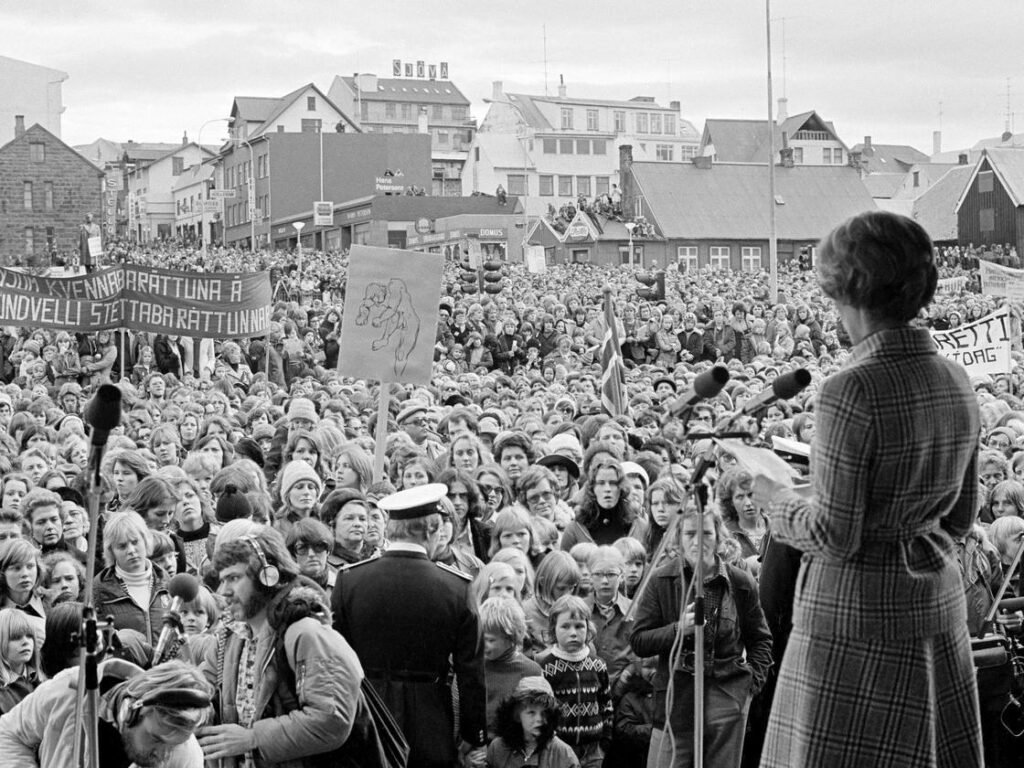
Fifty-one years after Iceland’s historic Women’s Day Off, the question of who sustains our communities remains as relevant as ever. On October 24, 1975, women across Iceland did something extraordinary. They stopped working. They walked away from offices, factories, schools, and shops. They refused to cook, clean, care for children, or perform the countless household responsibilities that ordinarily occupied their days. For twenty-four hours, they withdrew the labor that kept their country functioning.
And Iceland came to a standstill.
An estimated 90 percent of Icelandic women participated in what became known as the Women’s Day Off, or Kvennafrídagurinn. Schools struggled to operate, businesses closed, and thousands of women gathered in Reykjavík to demand recognition, equality, and change. The message was unmistakable. Women’s work was indispensable to society, even when it went unpaid or unrecognized.
Fifty-one years later, the anniversary invites us to reflect on a question that extends far beyond Iceland: Who holds our communities together, and why do we so often fail to recognize their contributions?
When Absence Made the Invisible Visible
The Icelandic Women’s Day Off emerged during the United Nations International Women’s Year, when women worldwide questioned established social and economic inequalities. In Iceland, women faced significant wage disparities, limited political representation, and social expectations that placed primary responsibility for domestic life on them. Women’s organizations, representing different political perspectives and social backgrounds, came together around a simple idea: demonstrate the importance of women’s labor through its absence.
The organizers deliberately called the action a “day off” instead of a strike, making participation more accessible to women who might otherwise have hesitated to join a political protest. The consequences were immediate. Schools and businesses struggled without female employees. Fathers suddenly found themselves responsible for children and household tasks. Ordinary daily routines became difficult to maintain.
The demonstration revealed something that economic statistics and political speeches had failed to communicate adequately. Society depended on women’s labor in ways that were both extensive and frequently overlooked. The movement helped create momentum for change. Iceland adopted comprehensive gender equality legislation in 1976, and in 1980, Vigdís Finnbogadóttir became the world’s first democratically elected woman to serve as a national head of state.
These achievements did not resolve every inequality. Icelandic women have continued to organize and protest in the decades since. Yet the events of 1975 fundamentally changed the national conversation about women’s contributions and their place in society.
The Work That Rarely Appears in Economic Statistics
When we discuss labor, we often think about employment, wages, productivity, and economic growth. Yet an enormous amount of work takes place outside formal employment. Preparing meals. Caring for children. Supporting elderly relatives. Managing households. Looking after sick family members. Maintaining relationships and helping neighbors through difficult times. These activities are essential to everyday life, but many remain outside conventional measures of economic productivity.
According to the International Labor Organization, an estimated 708 million women worldwide were outside the labor force in 2023 because of unpaid care responsibilities. This figure shows the scale of an issue often treated as a private household matter. Unpaid care work influences women’s economic opportunities, financial independence, access to education, and participation in public life. It also supports the functioning of entire communities.
The COVID-19 pandemic made these dependencies very visible. When schools closed, health systems came under pressure, and families faced prolonged uncertainty; care responsibilities intensified. In many households, women absorbed much of the additional burden while continuing their paid employment or other responsibilities. What Iceland showed in a single day in 1975 became visible again, under very different circumstances, during a global crisis. Society depends on forms of labor that are often taken for granted.
Women’s Labor Through the Lens of Human Security
As a scholar of global security, I find the Icelandic Women’s Day Off particularly interesting because it raises questions that extend beyond gender equality and employment. Human security concerns the conditions that allow individuals and communities to live with dignity, meet their basic needs, and navigate threats to their well-being. We often discuss security through institutions, policies, economic systems, and government responses to crises. Yet people also experience security through everyday relationships and activities. A child who receives care, an elderly person who has someone to rely on, a family with access to food, or a community that maintains social connections during difficult times experience dimensions of human security that traditional national security measures rarely capture. Women support much of this everyday security. Their contributions include caregiving and household management, as well as transmitting knowledge, preserving traditions, maintaining social networks, and organizing informal support systems. These activities can become very important when communities face economic hardship, environmental change, public health emergencies, or demographic decline.
Yet recognizing women’s contributions also requires examining the unequal distribution of responsibility. When a community depends on women’s unpaid labor to maintain essential forms of care and support, that dependence can create vulnerabilities for the women themselves. Their time, economic opportunities, health, and personal aspirations may be constrained by expectations that they will always be available to care for others.
This raises an important question: Can we describe a community as resilient if its resilience depends on the continuous, unrecognized sacrifices of some of its members?
From Iceland to the Danube Delta
This question resonates with my own research among women in Romania’s Danube Delta. The geographical and historical contexts are very different. Yet the experiences of women in small, geographically isolated communities offer another perspective on the relationship between everyday labor and human security. In the Danube Delta, women have long contributed to their communities’ survival and continuity through work that extends beyond formal employment. They have raised families, maintained households, preserved culinary traditions, transmitted local knowledge, and sustained relationships across generations. Their experiences also reflect the challenges of living in communities affected by environmental change, economic uncertainty, migration, and limited access to services.
Through my research and conversations with women in Sfântu Gheorghe and other Delta communities, I have become increasingly interested in how these everyday contributions shape community resilience. In my recent book, Resilient Daughters of the Danube Delta: Women, Human Security, and Environmental Change (Mosila, 2026), I explore how women’s everyday experiences reveal dimensions of human and gender security that conventional security frameworks frequently overlook. Their caregiving, ecological knowledge, cultural practices, and social relationships demonstrate how security is sustained through ordinary activities, even as the women themselves face environmental, economic, and social vulnerabilities. Preserving a traditional recipe, telling a family story, or passing on knowledge about local life may seem ordinary. Yet these practices connect generations, sustain cultural identity, and reinforce belonging.
My research has also reminded me that women’s lives cannot be reduced to their responsibilities toward others. Their stories contain personal ambitions, disappointments, achievements, difficult decisions, and experiences that deserve recognition in their own right. This matters when discussing resilience. Women are frequently praised for their ability to endure hardship, adapt to difficult circumstances, and hold families together. Such recognition can be meaningful, but it can also obscure the conditions that make this endurance necessary. Resilience should never become an expectation that women must continuously compensate for inadequate services, limited opportunities, or the absence of institutional support. The women of the Danube Delta, like women elsewhere, deserve recognition as individuals whose security, dignity, and aspirations matter as much as the communities they help sustain.
The Difference Between Recognition and Change
One of the most important lessons of Iceland’s Women’s Day Off is that recognition alone is insufficient. The events of 1975 made women’s contributions visible, but meaningful change also required legislation, institutional reforms, and continuing public engagement. This distinction remains important today. Celebrating women for their caregiving, adaptability, and contributions to community life does little to address inequality if the underlying responsibilities remain unequally distributed. A society may praise mothers while failing to provide adequate childcare. It may celebrate women who care for elderly relatives while offering limited support for caregivers. It may describe rural women as resilient while overlooking the economic and social challenges they face. The language of appreciation can coexist with structures that continue to place disproportionate demands on women.
From a human security perspective, this matters because community well-being cannot be separated from the well-being of the individuals who sustain it. Community resilience requires access to resources, meaningful opportunities, social support, and institutions that distribute responsibilities more equitably. Women’s contributions deserve recognition, but women also deserve the freedom to determine how they use their time, pursue their ambitions, and participate in society.
Fifty-One Years Later, the Question Remains
The documentary The Day Iceland Stood Still, directed by Pamela Hogan, revisits October 24, 1975, through the voices and memories of women who participated in that extraordinary moment. The anniversary also brings renewed attention to Áfram stelpur!, or “Forward, Girls!”, a song that became associated with Iceland’s women’s movement and its demands for equality. Something remarkable about a protest is that it continues to resonate more than half a century later. Perhaps its enduring significance lies in the action’s simplicity. For one day, women stopped doing what everyone expected. Their absence revealed the extent of their contributions.
Yet the lesson of October 24, 1975, goes beyond recognizing women’s labor. It asks us to reconsider how societies define work, how they distribute responsibilities, and whose contributions they consider valuable. These questions remain relevant in Iceland, Romania, and communities worldwide. They matter when we consider human security and resilience, because communities’ ability to withstand hardship depends on the well-being, opportunities, and dignity of the people within them.
Fifty-one years ago, Icelandic women demonstrated what happened when they stopped holding society together. Today, perhaps the more important question is why so much of that responsibility still falls on women’s shoulders. And what would it take to build communities where that responsibility is shared more equally?
References
Directorate of Equality. (2026). 50 years of gender equality legislation. https://island.is/en/o/directorate-of-equality/news/50-years-of-gender-equality-legislation
Hogan, P. (Director). (2024). The day Iceland stood still [Documentary film].
International Labor Organization. (2024, October 29). Unpaid care work prevents 708 million women from participating in the labor market. https://www.ilo.org/resource/news/unpaid-care-work-prevents-708-million-women-participating-labour-market
Kvennasögusafn Íslands [Women’s History Archives]. (n.d.). Kvennafrí [Women’s Day Off]. https://50ar.kvennasogusafn.is/kvennafri/
Mosila, A. (2026). Resilient daughters of the Danube Delta: Women, human security, and environmental change. Cambridge Scholars Publishing.
Mosila, A., & Balan, M. (2025). Women, human security, and environmental change in the Danube Delta’s village Sfântu Gheorghe. Security and Intelligence, 1–15. https://gsis.scholasticahq.com/article/144359-women-human-security-and-environmental-change-in-the-danube-delta-s-village-sfantu-gheorghe
University of Iceland. (n.d.). The legacy and international impact of the 1975 Icelandic Women’s Day. https://english.hi.is/research/legacy-and-international-impact-1975-icelandic-womens-day