
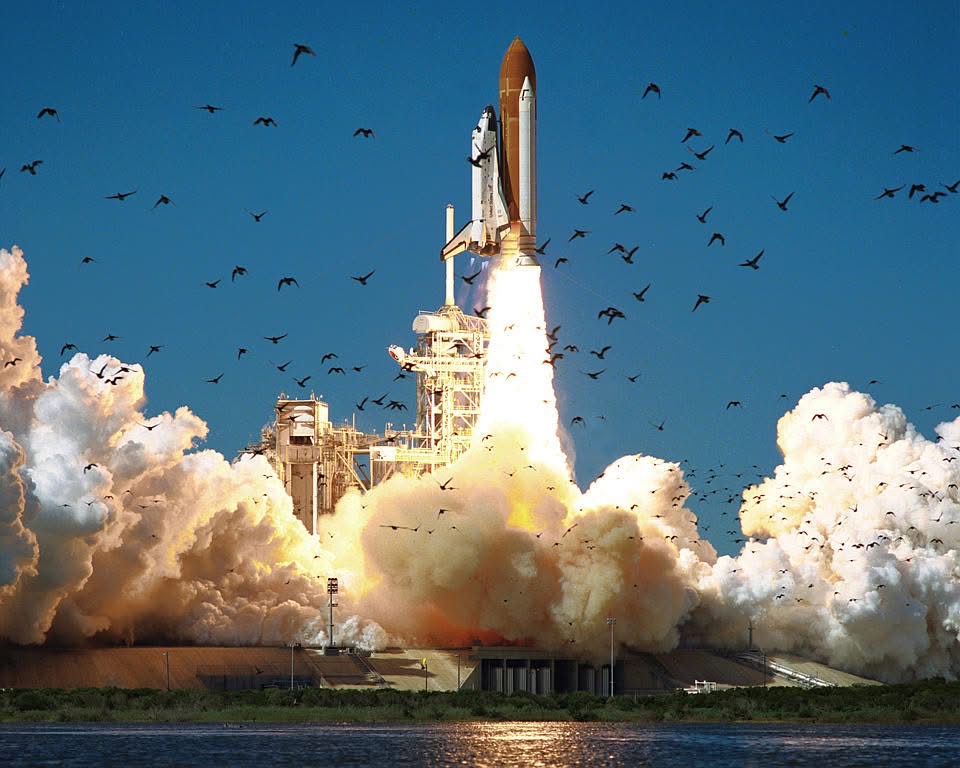
On January 28, 1986, the Space Shuttle Challenger disintegrated 73 seconds after liftoff, killing all seven crew members. It was not a mystery, not an unforeseeable accident, and not a failure of imagination. It was a failure of decision-making under pressure, made by people who knew better and convinced themselves otherwise.
Forty years later, Challenger still matters. Not only as a tragedy, but as a lesson that space is not dangerous because it is hostile. It is dangerous because humans bring their institutional weaknesses with them.
Where We Were Then: Optimism, Pressure, and the Illusion of Routine
In the mid-1980s, spaceflight was being reframed as normal. The Space Shuttle was sold as reusable, reliable, and increasingly routine. Launches were scheduled tightly. Delays were politically inconvenient. NASA was under pressure to perform, to demonstrate competence, to show that spaceflight was no longer experimental but operational.
That framing was the seed of the disaster.
Engineers at Morton Thiokol had long warned about the O-ring seals in cold temperatures. On the eve of the launch, they explicitly recommended delay. Management overruled them. The risk was known, but it was normalized, treated as acceptable because catastrophe had not yet occurred.
Sociologist Diane Vaughan later named this phenomenon the normalization of deviance: when repeated success in the presence of known flaws leads institutions to redefine danger as acceptable variance.
Challenger did not fail because of ignorance. It failed because warning signals were absorbed, reframed, and ultimately silenced by organizational momentum.
Space Security Before We Had the Language
In 1986, we did not yet speak openly about space security the way we do today. But Challenger was a security failure in every meaningful sense. It was a failure to protect human life. It was a failure of institutional accountability. It was a failure to align technical truth with political decision-making.
Security is not only about hostile actors. It is about whether systems can resist self-deception under pressure. Challenger showed that even democratic, civilian institutions can drift into dangerous patterns when success becomes a performance requirement rather than a safety outcome.
A Personal Reflection: Learning to Hear the Quiet Warnings
While I experienced Challenger in real time, as a child, I also encountered it later through training modules, safety briefings, accident reports, and quiet institutional rituals meant to keep memory alive.
At NASA, Challenger and Columbia were never just historical case studies. They hovered in the background of meetings, reviews, and decisions, often unspoken but understood. They were reminders that failure in space rarely announces itself loudly at first. It appears as small anomalies, inconvenient data points, engineers who are overly cautious, and timelines that start to feel more important than questions.
What stayed with me most was not the technical detail, but the cultural lesson: disasters are often preceded by moments when someone speaks up, and is talked past.
Space organizations are full of smart, dedicated people. The danger lies not in incompetence, but in systems that subtly teach people when not to insist, when not to escalate, when not to slow things down.
Those lessons shaped how I now think about space security. Not as a problem to be solved with better hardware alone, but as a human systems problem, one that depends on institutional humility, protected dissent, and the willingness to delay progress in the name of safety.
Where We Are Now: Crowded Orbits and Faster Decisions
Today’s space environment is radically different. Low Earth orbit is crowded. Commercial launch cadence is accelerating. Military, civilian, and private actors share the same orbital commons. Autonomy and AI are increasingly embedded in mission systems. Debris, interference, and escalation risks are no longer hypothetical. We have better technology, but we also have less margin for error.
Speed, competition, and strategic signaling now shape space decisions in ways that feel uncomfortably familiar. Launch schedules. Market pressures. National prestige. The temptation to treat anomalies as noise rather than warnings.
Space security today is not only about adversaries. It is about governance under acceleration. It is about whether institutions, public and private, can preserve safety cultures when failure becomes expensive, embarrassing, or politically inconvenient.
The Enduring Lesson of Challenger
Challenger teaches a quiet but devastating truth: Catastrophe often begins with people doing their jobs exactly as they are rewarded for doing them.
Real security requires systems that protect dissent, elevate expertise, and slow decisions when evidence demands caution. It requires resisting the story that progress must always be visible, fast, and uninterrupted.
Space will always be unforgiving. The question is whether we remain honest enough to respect that fact.
Forty years later, Challenger is a memorial and a warning, still active, still relevant, and still waiting to see if we’ve truly learned.